Explore Our Case Studies
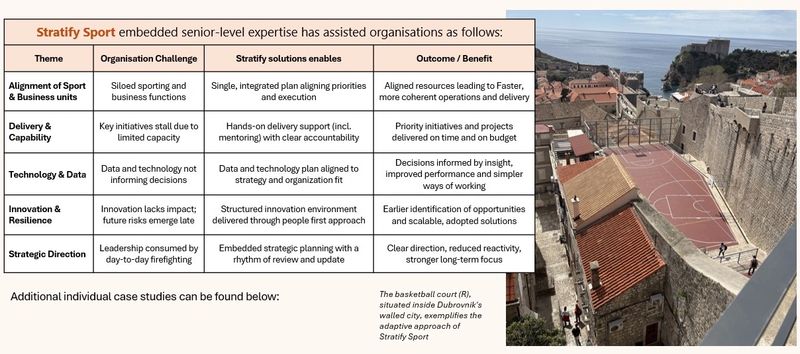
Case studies demonstrating our approach of working alongside existing teams to complement internal knowledge, co-create solutions and foster people development.
Case Studies
Situation
Participation data was fragmented and inconsistent, limiting the organisation’s ability to understand participation trends, retention patterns, and the strength of the talent pipeline. Insight existed, but it was locked within disconnected systems and individual programmes.
Task
Provide leadership to centralise participation data and build a single, trusted view of the sport enabling evidence led decisions on growth, performance pathways, investment, and community impact.
Action
Led and mentored the project team to integrate registration, competition, coaching, and workforce systems into a unified data hub. Established consistent data standards, improved data quality, and connected participation behaviour with commercial revenue and community investment. This created a clear view of participation journeys, drop‑off points, and growth opportunities across the sport.
Result
The organisation shifted from simply counting participants to understanding behaviour, retention, and impact. Decision making improved across participation and talent pathways, and leaders were able to quantify Social Return on Investment (SROI), clearly demonstrating the social and economic value of community participation programmes. The sport gained a trusted evidence base that strengthened funding cases, targeted interventions, and supported long term growth.
Establishing an Innovation Programme
Situation
The organisation identified a strategic need to establish a formal innovation programme, working with government agencies to address shared challenges and translate innovation into practical, sport wide outcomes.
Task
Design an innovation programme that aligned government priorities with the sport’s commercial, technological, and organisational capabilities, while embedding innovation as a sustainable, long term organisational capability.
Action
Led a structured, people centred consultation process to shape the programme, with a strong focus on culture, collaboration, learning, governance, and repeatable processes. Engaged leaders, practitioners, and government partners to co‑design a model that balanced ambition with operational reality.
Result
A formal innovation programme was established that directly supported performance outcomes, strengthened collaboration with government partners, and built long term organisational resilience through embedded innovation capability. The organisation gained a repeatable, trusted mechanism for turning emerging ideas into practical, scalable solutions.
Elite Sport Technology Stack review
Situation
An elite sport technology programme was delivering poor alignment, low adoption, and limited return on existing investment.
Task
Review the programme to improve alignment with practitioner needs, increase adoption, and unlock greater value from current spend.
Action
Gathered direct user feedback, assessed vendor performance, and identified capability and training gaps. The review demonstrated that most tools were under‑used rather than unnecessary, enabling consolidation around how practitioners actually worked, supported by clearer ownership and targeted training.
Result
Technology was streamlined, adoption increased, vendor relationships improved, and the organisation unlocked 12% additional value from its existing technology budget without increasing spend, delivering measurable performance and financial impact.
Blend the colours - Alignment between HQ and Clubs
Situation
The relationship between the National Governing Body and professional clubs needed to evolve from a transactional model to a shared‑value partnership.
Task
Supported this transition by strengthening strategic alignment, clarifying roles and decision rights, improving collaboration between boards and management, and establishing a more effective and durable operating model.
Action
An Organisational Effectiveness Review was undertaken with engagement of more than 100 staff and key stakeholders across the system. The process assessed organisational impact, sentiment, and cultural and operational challenges. Insights from this engagement informed a series of facilitated workshops focused on culture, behaviours, and outcomes. A Plan‑on‑a‑Page planning approach was introduced, supported by six‑monthly review cycles to maintain alignment and accountability.
Result
The process resulted in 18 agreed recommendations that repositioned the Governing Body as an enabling, supportive partner to the professional clubs. Strategic alignment and decision‑making were strengthened, roles and relationships clarified, and a sustainable operating model embedded through regular review, shared accountability, and improved collaboration.
Global knowledge exchange and collaberation
Situation
Sports organisations were facing shared technology challenges across markets, with limited coordination, duplicated effort, and slow responses to industry change.
Task
Create a trusted, international forum to enable collaboration, shared learning, and the development of scalable technology solutions.
Action
Facilitated a global network of sports technologists, establishing a regular, structured rhythm for knowledge exchange and collaborative solution development across jurisdictions and disciplines.
Result
Alignment improved, duplication reduced, and solution development accelerated. The network fostered a more open, change‑ready culture, enabling faster, more coordinated responses to industry shifts and emerging challenges.
Strategic Risk Management
Situation
The organisation’s approach to strategy and risk had become fragmented, with risk treated as a retrospective compliance exercise rather than a tool for informed decision‑making.
Task
Integrate strategy and risk into a single, forward ooking framework that supported execution, resource allocation, and future‑focused decision‑making.
Action
Designed and facilitated a structured process to cascade strategy into clear execution priorities and reframe risk as an enabler linked to strategic objectives and future opportunities. Board, leadership, and senior teams were actively engaged to clarify intent, identify key risks and opportunities, and apply horizon scanning to capture long‑term scenarios and emerging issues.
Result
Risk management shifted from compliance‑led to decision led. The organisation improved its ability to anticipate change, allocate resources effectively, and plan confidently for future challenges, with stronger alignment between strategy, risk, and execution.
World Class Programme Review
Situation
The World Class Performance Programme required review to ensure competition outcomes, player progression, and resources were optimised for medal‑level performance.
Task
Assess the effectiveness of the programme and identify improvements to better support athletes, coaches, and performance staff.
Action
Undertook a system wide review focused on listening to athletes, coaches, and performance staff to understand what enabled day‑to‑day performance and where gaps or friction existed. Recommendations were developed across programme structure, support services, and governance.
Result
A more focused, athlete centred programme was established, improving confidence in the system, strengthening delivery across partners, and better supporting consistent medal level performance.
Motor Racing - Peak Performance Strategy
Situation
A leading Formula One team sought to improve consistency and resilience of the Driver, Senior Leadership and Racetrack Team under the extreme demands of elite competition.
Task
Design and implement a performance‑led preparation and resilience strategy that aligned drivers, leadership, and the wider crew around winning performance.
Action
Implemented an integrated approach aligning mental and physical preparation with the operational demands of F1, embedding these principles across leadership practice, driver preparation, and race‑team operations.
Result
Decision‑making under pressure improved, focus and energy were sustained across the season, and the conditions for peak, consistent performance were created when it mattered most.
Football Brand Equity - voice of the fan
Situation
The football club identified an opportunity to optimise brand equity by better understanding supporter perceptions and strengthening alignment between brand, performance, and commercial activity.
Task
Capture authentic fan insight to inform brand positioning and identify where the club’s brand was under or over performing.
Action
Undertook a targeted brand review underpinned by a comprehensive fan survey exploring identity, emotional connection, matchday experience, communications, and values. Insights were analysed to establish a clear, evidence‑based view of supporter priorities.
Result
Practical recommendations were developed to strengthen emotional connection, refine brand positioning, and better align on‑field performance, fan experience, and commercial strategy, ensuring the club’s brand was driven by supporter voice and designed to deliver long‑term loyalty and value.